I once spent some wondrous months in the Pilliga Scrub, a vast scree of native Australian forest gone feral in north-west New South Wales. I was working with John Cruthers, Joel Peterson and Eric Rolls, grafting a film out of Eric’s marvelous vast scree of a book, A Million Wild Acres.[i]
One afternoon Eric took me unusually deep into the forest, proffering the chance to meet a white man we will call Muller, whom I had heard about and whom Eric had met a couple of times. The summer day had been parching, breezeless mostly, except for some fluky little gusts and spiralling willi-willies that haggled with the Land Rover whenever we broke out of the foliage-cover and traversed a clearing. But by the time we got close to Muller’s compound, the sun was dropping and some humid clouds had climbed out of the river junction not far away. Before long, light rain was spritzing the dusty pines and eucalypts, releasing into the air a welcome round tang that soothed the soft palate like a lozenge.
Eric drove around for a bit, doing that directional divining of corrugated tracks that mystifies anyone new to the Pilliga. Finally we pulled up at a walking track and ventured in. Ten minutes from the road, we came upon a clearing bounded on all sides by stacked short bolts of timber that were commercially useless but aesthetically thrilling, with their patterns of knotty convolutions and sappy striations presenting all the colours of blood in sculptural arrays aligned in every which way as if to give shifting volume and spectral tone to the gloaming air. Eric called out several times: a few words, including Muller’s full name, but mostly variants of coo-ee noises that were more like birdcalls or the creaking of timber, as if he was loath to startle the place with too much human intrusion. But all was quiet, deserted right now except for us, so incursive and curious.

I remember padding around the compound awe-struck, alarmed by the noise my boots were generating in the red gravel. I recall calculating how it would have taken one man maybe several thousand mornings of work to make just the timber stacks in this ‘installation’, let alone all the other details of the place. And I recall thinking that this must be all Muller does: tend and change the place every day.
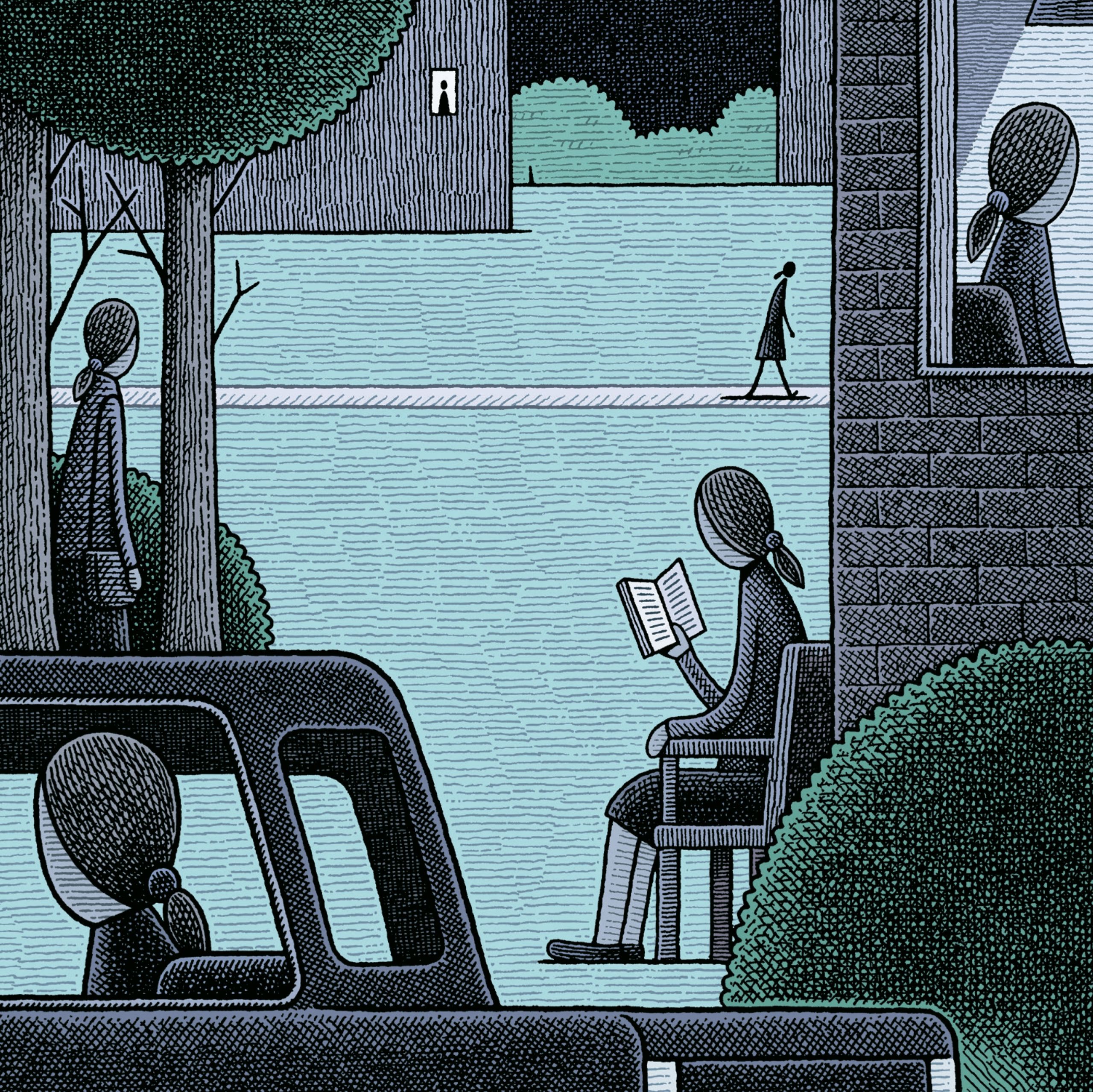
The compound had been a timber-mill once but it had undergone some slow metamorphosis, till now it was a devotional kind of site. Devotional to what, I still can’t say exactly, but devotional all the same. For it could have been sustained in this serene appearance only by dint of a devoted lifetime spent designing and laboriously adjusting and maintaining. And a good stint of custodial labour had occurred recently. For the entire clearing—about half the size of a cricket field—had been raked so the ground was free of footprints and was linearly pulsating with confluences of curves and rectangular tracts that seemed to be mustering the breezes in cooling little arabesques all around us.
At least, the compound had been free of footprints till we had blundered in. Which makes me think the raking was not only one of the most beautiful aesthetic configurations I have ever seen but also some sly and leery method of surveillance.
I couldn’t resist exploring, all the time listening for other footfalls and the noise of a rifle cocking. Near the northeast of the clearing, zinging with a keen sensory acuity that had been stimulated by the mystery and the delicacy of the place, I ventured over to a covered contraption. It was a timber structure that I can best describe as an log-entablatured shelter, roughly assembled but also distinguished with proportions and a style worthy of epithets like ‘minimalist’ and ‘Zen’. Inside, an old wheel-less truck was installed on blocks. From the truck’s unimpeded back axles several heavy drive-belts extended in different directions across the graveled compound, connecting to blade-benches and saw-pits. Evidently you could start the truck, slip it into gear and thereby have an entire sawmill humming and zinging, complete with a feature whereby one driver-belt conveyed sawdust out to a fragrant disposal pit on the southern edge of the site.
Panning to the left, I noticed there was a small wooden shack nearby. Well, it was more like a roofed box, two metres long, one metre wide, the height of a man standing. Peering through the door, I saw that it was an enclosed bed, empty right now but installed there at the centre of the compound, insulated from intrusion by sixty paces across the crunchy gravel on all sides. From the bed, I had a direct sightline to the main saw-pit and out to the sector of the perimeter where Eric and I had ventured in. Alongside the bed, a car battery was connected to a radio that sprouted a high wire aerial, hand-made, Calder-esque and pivotable to catch a full dome of transmission in the huge sky.
As the sun waned, I had time to discover just one more detail. Out on the western boundary of the clearing, behind a thin stand of gum trees, there was another simple structure that you could barely see from the precinct proper. It was a smaller version of the construct that housed the truck. As I closed in on it, I could see that it was a kind of miniature temple. Suspended from the rafters or balanced on plinths made from logs, there were maybe thirty ‘relics’ of the forest—startling things, some of which might have been macabre except that each object’s relative placement and scale and particular qualities all mitigated systematically against repulsion. It was a wondrous and reverent array. here was a delicate skeleton of a small marsupial coiled as if about to spring back to fleshy life; there was a large split rock, a metre across, showing a fossilised fern print; a melted black Bakelite telephone; the bonnet mascot of an old Chevrolet; and a shiny clean skull that might have been of a cat but was larger than any domestic feline I’d ever seen. All these things were displayed like treasures the forest had yielded to a dutiful fossicker. The collection was strange, but special.
Devotional. That word came to me again. The roofed structures I’d found were like emotional compression chambers. Their placement, their volume, their material, their contents, the counterpoint between the cool grey light inside and the sharper brightness outside: all these features rendered each structure into a compressed zone that intensified a particular emotional charge within a larger compound that was already extraordinarily atmospheric, so deliberately rarefied and intensified in comparison to the rest of the forest.
I remember marvelling at how dextrously Muller had made and located these three aesthetic ‘power-plants’—the truck-shelter, the sleeping box and the reliquary—inside the bigger force-field of his raked and wood-stacked compound. He knew something about rhythm, about establishing and off-setting frames in space, matter and time; he knew how to manage bounds that counter-posed relaxation and tension, vacuity and intensity, downbeat and upbeat, the one side and the other side. There was something about wildness and domesticity in there too, nature and culture itching at each other. These thoughts undulated in me as I daydreamed in the reliquary.
Back at the edge of the clearing, Eric whistled. Having installed himself on a stump near one of the wood-stacks, he had been jotting in his notebook, taking care to be less of a sticky-beak than I had been. He called out that he was keen to go and find the way out of the forest before all the light was gone.
As we trudged to the walking path, I turned for one last view of the site. In wide-shot I could see how the record of our visit was footprinted all over the clearing. As stark as a CCTV report, there was the single track that Eric had made over to his tarrying-spot, and there was the record of everything I had inspected, evidence of how snoopy I had been, where I had come in and out of the compound, how I had breached its porous boundary, brought my strangeness in and bandied it about.
Driving back to our base camp in the last half-hour of evening, we could smell recent burning. The tasty aroma of damp ash. Now and then we could see where a gentle fire had knocked back some of the undergrowth but had not taken to the trees. Eric noted the peculiarities of the burning pattern. When we merged on to a larger track we came upon a Forestry Department truck. As is usual in the bush, we stopped for a chat, keeping the engine running. No, they had not done any burning; they were on the way back from road maintenance, as the small ‘Bobcat’ grader on the trailer behind the truck testified. ‘Hmmph, funny,’ said Eric. ‘Yeah, funny,’ said one of the Forestry blokes, who then bunted his truck out of neutral and waved a gesture as they beetled off, as if to say funny’s just ordinary.
I was intrigued and didn’t calm down overnight. Next morning I badgered Eric to go back after lunch.
This time we tooted the Land Rover’s horn as we approached the pedestrian path, and once we were walking, Eric coo-eed ahead. When we got to the edge of the clearing, Muller was standing there, his single line of footprints graphic against the freshly raked ground of the entire compound. He was spry, strong, smelly. Maybe sixty-five years of age, but this was indiscernible, truly. He was plainly suspicious, not to say hostile, until Eric spoke and explained how they’d met years before and how they had a couple of mutual acquaintances in town. Muller relaxed a tad, unclenched his jaw and started talking quickly in a soft brogue that was ‘country Australian’ but sometimes had Irish and sometimes German patterns in it. We asked a couple of times if he had any objection to our filming. He hefted the camera, cocked an ear to listen to its whirring, showed some interest in the vinyl dust-cover, and made no objection.
After attuning myself to his morse-code verbiage, I understood that a Forestry fella had told him this morning that there had been strangers about, but he knew this much from the footprints: two strangers, who’d never been here before, yes you two. Eric explained how we were interested in the history of the forest and how I’d been fascinated by his mill. I added that I thought his mill was beautiful. Muller registered that I was genuine, but it was clear the ‘beauty’ topic was not going to sway him much. I added that I was wanting to understand how everything that had happened in the forest was still producing effects there, still hanging around the place.
This seemed to light him up. He quipped, ‘Ghosts, you mean’. Not really a question. ‘Kind of,’ I replied. And he was off. He talked at pace about how he would see things sometimes at night and how the radio tells him stuff you would not expect it to. Outside of the specific environment we were standing in, this might have been crazy talk, and clearly he was living a hard life, but it seemed prissy to judge him by any standards I had walked in with. He was functioning in a place that remains aesthetically unmatched in my experience, and he was devoted to it somehow. Sustained by it too, not in body so much as in whatever spirit or mania drove him along day by day.
Once Muller had finished his ghost monologue, I seemed to have licence to ask him more questions. Most of the time he ignored them and I noticed that he had no censoring sieve between thinking and speaking. Living alone out here (by Eric’s calculations Muller had been here for more than forty-five years since first leaving the closest town to take over the family mill when he would have been in his late teens) … living alone out here he had probably always let his thoughts get vocalised as they formed. Decades of solitude had led to this: he did not talk to himself so much as he told the place what he was thinking. Anyway, one of my questions elicited a short, lucid response. When I asked him why he continued to work so hard every day making this cache of lumber that he plainly never made any attempt to sell, he said that the forest is always offering timber ready for cutting. I asked him about the fires we saw yesterday. He wondered out loud if I ever speak much to the Forestry fellas. I responded I never run into them, except for yesterday, which was not at all normal, and besides, I don’t live around here. He countered with a long stream of consciousness, within which there was some information to the effect that yesterday afternoon he had lit out from the compound when the clouds had come up because it was a good chance to do some firing in a nearby tract that needed some heat in it, because he was confident that the rains would come down with the sunset to contain the burn exactly as it had to go.
I was keen to get him talking more about this, for he had some fire-farming knowledge and an ecological philosophy. But he wanted to start the truck and cut some timber. So that is what happened.
He got the mill going. And it was beautiful. By which I mean there was an elegance and a design to it all, a sense of its rightness in cohesion offset by enigmas that drew you back to consider it repeatedly. In operation, the mill was loud, acrid and dangerous. But it was beautiful. Muller had made it so. Or at least it had become so as a consequence of how he had immersed himself in the place, in the feedback patterning of action and reaction amongst the trees over extensive time.
The blades kept humming and more bolts of timber stacked up. Until, after a while, Muller mentioned to no-one in particular that he was keen for us to go now, and it would be good if we didn’t come back. Which seemed fair enough to me. So I’ve never re-visited. Except often in my memory and sometimes in dreams, where the compound grows evermore vivid and telling.
Muller features for a few minutes in the film we made but I know I have never found the right context to bear witness to what I think is so significant about him. Straight away, I have to emphasise that these are just my interpretations, perhaps my projections. As far as I could tell, Muller himself cared not one bit about his meaning or about how a stranger might use his mill for rhapsodies and theories. He had no explicit thesis, no evident need for a reader or an audience. He was no local reincarnation of Henry David Thoreau. But he built his compound. It was rigorous and eloquent. And it means something.
I have thought about it all these years and I am just now getting a better grasp of how remarkable it was, that clearing in that forest. Muller’s compound and my encounter with him prompted my notion of the ‘changescape’, this idea I have that there are long-established aesthetic systems that are built purposefully to intensify our experience and to enhance our understanding of the complex dynamics that are at play when our natural, social, technological and psychological domains commingle and alter each other in this world that is full of mutability. Like Muller’s mill, a changescape is something predominantly aesthetic rather than pragmatic. Productive of understanding, primarily, a changescape is designed to produce cognitive and sensorial wealth rather than material profit. A changescape helps you think and feel so that you are engaged with the flux-infused world, so that you feel informed about that world’s maintenance and motivated by its momentum rather than distressed by its entropy.
[i] R. Gibson (director), J. Cruthers (producer), Wild, distributed by Ronin Films, Canberra, 1993, 16 mm film, 54 minutes’ duration,. E. Rolls, A Million Wild Acres: two hundred years of man and an Australian forest, Nelson, Melbourne, 1981.

This is an extract from the Introduction to Changescapes: Complexity, Mutability, Aesthetics, Ross Gibson, UWAP 2015.
Ross Gibson (1956–2023) was Centenary Professor of Creative & Cultural Research at the University of Canberra, working collaboratively to produce books, films and artworks and supervising postgraduate students in similar pursuits. Previously he held positions at ACMI, UTS and the Museum of Sydney.