Last month I was holidaying briefly in Port Fairy, in the southwest of Victoria. I was with my wife, who is from Warrnambool, the region’s largest town. Both loving the outdoors, we went for a walk on one of the southwest’s many beaches.
September’s around the time that long-distance migratory shorebirds start arriving back on northern Australian shores from their breeding grounds in the northern hemisphere, before moving down around Australia’s coastline, all the way to Tasmania. At the end of that month short-tailed shearwaters also return in their thousands to breed in densely packed colonies scattered along the coast, including at Port Fairy’s Griffiths Island. Birds, being highly mobile, undertake often astonishing migrations, covering thousands of kilometres and connecting far-flung continents.
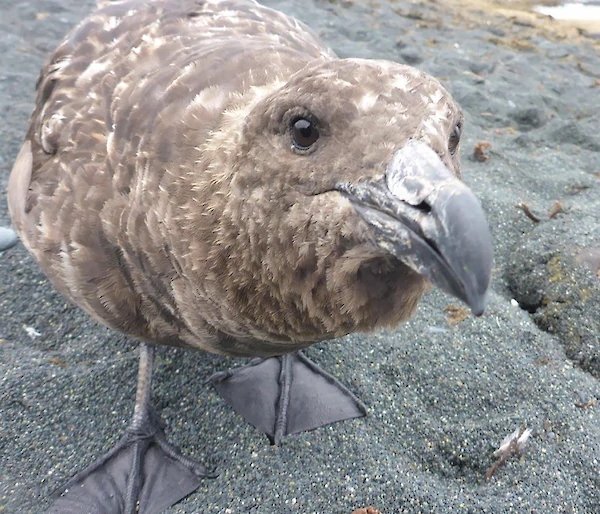
Which makes them a perfect disease vector for a highly infectious virus, such as the H5N1 strain of avian influenza – bird flu. Long-dreaded by Australia’s conservationists, ecologists and bird lovers, the flu arrived on this continent in June, when an infected brown skua – an Antarctic migrant – was detected in Western Australia. After appearing in South Australia and Queensland, it arrived in July in Portland, Victoria – only 55 kilometres in a straight line from Port Fairy. As I write this in early October, the website Avian Flu Watch (a tracking project by epidemiologist Dr Hannah McClymont and engineer Sheldon Uprichard) lists 786 confirmed virus detections in Australia, another 20 suspected cases, and 13 mass-mortality events, the latter with a total of 1420 sick or dead birds. Globally the virus is estimated to have killed millions of birds, and to have also infected more than one hundred mammal species – including humans.
On that beach in Port Fairy my wife and I got chatting to a local. ‘It’s not so much that you see dead birds,’ she said, ‘it’s that you don’t see any birds at all.’
One of the mass mortality events listed on Avian Flu Tracker, retrieved from an ABC news article, relates to the deaths of more than 1000 crested terns on offshore islands in South Australia.
There is more death in the wild than we realise. Nature doesn’t waste anything, and it doesn’t take long for dead animals to be eaten and disappear. So seeing photos on social media of dead or dying birds, reading stories from wildlife rescuers of colonies littered with corpses, has been unusually distressing. The distress is compounded by the disregard from people who should know better: on Instagram, in response to CNN news coverage of penguins on Phillip Island being vaccinated against the virus, commenters fumed about what they saw as yet another intrusion by humans into the natural world. ‘Leave them the fuck alone!’ ‘Sick pharma cult. Next they’ll come for us.’ ‘THEY’VE SURVIVED ICE AGES, PREDATORS, CLIMATES SHIFTS AND 60 MILLION YEARS OF EVOLUTIONARY PRESSURE… BUT APPARENTLY DAVE FROM THE DEPARTMENT OF HEALTH HAS DECIDED THEY NEED A JAB.’
That some of these comments – a minority, thankfully – come from people who profess to love birds reflects a deep disconnect. It assumes that any human interaction with a wild animal is somehow a crossing of boundaries. It assumes that ‘human’ and ‘nature’ are two distinct categories. It’s the same mindset which has got us into the planetary environmental mess we’re in already.
Once, years ago, I was asked by a radio interviewer what we would lose if migratory shorebirds went extinct. Because the question was about economic value, I struggled to answer. But these birds are as iconic to this continent as the emu, the kookaburra and the wedge-tailed eagle. That they live as migrants – and global marathoners who choose us – is something to celebrate, not ignore.
The federal government’s commitment to fighting bird flu has been paltry – in keeping with their commitment to conservation in general. As each new bird flu outbreak is reported, government ministers assure us that the outbreak has not reached the agricultural sector – as if chickens on poultry farms whose bodies are commodified are the only birds that matter.
There is not a single part of this world left that we aren’t constantly encouraged to quantify in dollar terms, put on a spreadsheet. For many of us, birds are a brief respite from all that. Maybe that’s what we stand to lose. The birds, though, stand to lose everything.
…
Harry Saddler is a writer based in Melbourne. His books about nature and the environment have been shortlisted for the Queensland Literary Awards and the Prime Minister’s Literary Awards.
Photo credit: Marcus Salton/AAD
