MEANJIN: I wonder what you’d make of today’s political climate for writers. You started Meanjin in a time of war because it was ‘our duty to do so’. For you, that undertaking was a necessary one: to ‘talk poetry’, to champion ‘literature and art, poetry and drama’. With an unwavering belief in the power of the artist, you took to this as a project of national significance –
CLEMENT BYRNE CHRISTESEN: Let us not be misunderstood. The chief responsibility of the man of letters—a responsibility he shares with other creative artists—is towards his art. While concerning himself with present-day social and political problems he must retain his artistic integrity. As a responsible member of society he cannot dissociate himself from the problems which face modern society; as a writer he must interpret these with the greatest artistic skill and imagination of which he is capable. He can no longer seek to escape his responsibilities as a man by pleading ‘art for art’s sake’; nor can he jeopardise artistic standards by claiming the urgency of his social responsibilities.1
MEANJIN: Of course, you were never one for the æsthetic alone; that sense of the responsibility of the writer means so much more than a comportment toward her, their or his art. When we look at the consequences today for artists calling out injustices and atrocities in a time when so many feel powerless to speak out, it’s difficult to reconcile that sense of responsibility with the increasing complacency of people in positions of power.
CBC: These wartime experiences have surely made the creative artist realise (if he lacked that realisation before) that his responsibilities in world-society have increased in weight and in urgency. For a century Western writers have known the temptation of social irresponsibility: this has been almost the proprium of a literary career. The writer can no longer succumb to that temptation without alienating himself from the most progressive elements in present-day society. In the light of events leading up to and during the second world war the man of letters must be held responsible for the decision he makes. Jean-Paul Sartre, one of the leading writers of the new generation in France, claimed recently that there were writers in Europe who, when reviled or punished for having hired out their talents to the Germans, registered grieved astonishment: ‘Why,’ they asked, ‘is one responsible for what one writes?’ This miserable heritage of irresponsibility must not be allowed to continue.
Since by their very existence writers influence their time, they must decide, deliberately, how this influence is to be used. What will be the pattern of life in postwar Australia? What reforms must be effected?2
MEANJIN: What about the responsibility of the people we elect to represent us? Surely we also need to raise the bar in terms of what we expect of our political leadership?
CBC: I cannot recall a single utterance by a Minister of the Crown which revealed any sufficient comprehension of the needs of Australian intellectuals, writers, artists, or of the contributions they have already made to the enrichment of our national life.3
MEANJIN: Understood – I mean, you weren’t working in the most inspirational of times in that regard, but shouldn’t we expect our political leaders to be cultural leaders? To rise to the responsibility of what being a public figure truly means?
CBC: Could one imagine an Australian ‘public figure’ – the chaps who speak fatuous drivel at Australia Day functions, who lay foundation stones, open church bazaars, confer degrees or welcome foreign dignitaries—making a statement along those lines?4
MEANJIN: Thankfully these days the chaps have diversified somewhat – not enough though! – and yet we still don’t see the arts widely understood across our various levels of government. It’s deeply frustrating, given what we know about the power of the arts to strengthen us in every way.
CBC: If a government can contribute to the security and social welfare of a citizen, why can it not also minister to the needs of his spirit, to the backing of all forms of art – not by attempting to control them or to use them as propaganda to further the more material ends of the State, but by encouraging them to keep alive and free? Art is individual, but politics must by its nature deal with the mass, and encourage art to interpret for the individual the inner meanings of the external world. The State can stand above Society, and in memorable periods of a nation’s life can be the great critic, shaper, judge, setting patterns and the style of the common life. Then the political leader along with the poet and artist becomes the shaper of his time. Since on the whole we have almost conquered the problems of economic poverty, isn’t it time we set about creating for our people things that feed the mind and spirit as well as the belly? We need to consider as a matter of some urgency our Australian concept of the ‘public happiness’.5
MEANJIN: A beautiful approach – and a necessary one. I am seeing a lot of calls for joyfulness right now. Ways to keep finding the joy in what we do.
CBC: Yes, by all means let there be song! ‘No faith can last that never sings,’ wrote Lascelles Abercrombie. Because Death is polishing old philosophies in a world-society unbelievably deliquescent, insanely chaotic, there surely is no reason why we in this eucalyptus-scented World’s End should necessarily have to refrain from celebrating Pan and Aphrodite, Apollo in his fields of amaranth. (We thereby receive convincing proof, if further be necessary, of our own insanity!) But it can truly be claimed that unless we turn, with spontaneity and gladness, to Beauty and Passion, to frankness and laughter, we are doomed. In our contemporary literature we can do much in this respect, particularly in poetry. We believe that in wartime poetry is as necessary as bread. Therefore, sing up, poets all, courageously, confidently!6
In the meantime – work, write, experience, form a synthesis.7
MEANJIN: And so we continue, eighty-five years on, and those who have come before me grapple with your legacy, and I with theirs, and we continue to ask questions, because this is the way we create the future. I want to be able to envision a time when editorial independence is championed as necessary to the project of fostering a literary community. What advice would you offer to Meanjin’s future editors when we find ourselves at turning points –
CBC: – I’m afraid it would take me many pages to set out my ideas on the subject. It is experience that counts most of all; one can’t learn except by doing the job yourself and overcoming all sorts of problems. I could be of little help without examining the material you propose using. Aim at quality; don’t be afraid to ‘edit’ an article. Try to get a balance in the magazine between creative literary work—short stories, poetry—and critical work. I prefer original imaginative work rather than writings about writings! Format is important: typeface, paper, layout, etc. Don’t crowd the pages too much; leave good margins, top, sides and bottom, and plenty of space for the headings. I’ve always had to crowd Meanjin pages far too much.8
MEANJIN: Look thanks Clem but I was thinking more in the political sense: negotiating our convictions. To sustain the grit, the guts, the steel to maintain an editorial vision against the bureaucracy and hostility you faced, how do you hold vast to your vision for Australian writers –
CBC: – let us glance at the Australian scene as it affects the writer. The past twelve months have caused the socially-conscious writer increasing uneasiness. The attacks by illiberal, irrational, anti-democratic elements in the community have been intensified. While the campaign has not reached the hysterical pitch of pre-election America, the writer here has nevertheless been made uncomfortably conscious of the threat to the free expression of progressive views-and to his own vulnerability. There have been repeated witch-hunting outbursts in the Federal Parliament which have amounted to calculated intimidation. By some public men the technique of the political smear has been brought to a fine art.9
Meanjin enters upon its eighth year of continuous publication, more confident perhaps than ever before of the value of the ‘little magazine’, more determined to join issue with those elements in society which determined to straight-jacket and destroy those writers who dare to question existing values and institutions.10
MEANJIN: All too often artists don’t appreciate that influence – and so much of that, of course, lies in the precariousness of being an artist. What do you say to writers who are feeling pressured into a silence at a time when we need their work more than ever before?
CBC: The bourgeois revolution has reached a dead-end; regression, and irrational modes of thought, are manifest everywhere; culture goes obscurantist; politics become more and more totalitarian. In this period of profound social frustration, in which all roads ahead seem blocked, when the world-wide antagonisms between actual policies and formal principles have become too acute to be bridged by even the most powerful propaganda, we have – the New Failure of Nerve.
But Meanjin is for enthusiasm over cynicism, for endeavour as against defeatism. We can have no dealings with literary defeatists who, like the political defeatists, are doing enormous harm to the Allied cause. Emphasis on silence rather than on speech does not seem to us to be a solution of the lantana-tangled problems confronting the nation to-day.
The call to the nation’s imagination will come from the younger writers, some of them as yet unknown, many of them on active service. Meanjin will provide a medium for their vast indignation.
Meanjin is an Idea—and we’re damned if you can wring the neck of an idea.11
…
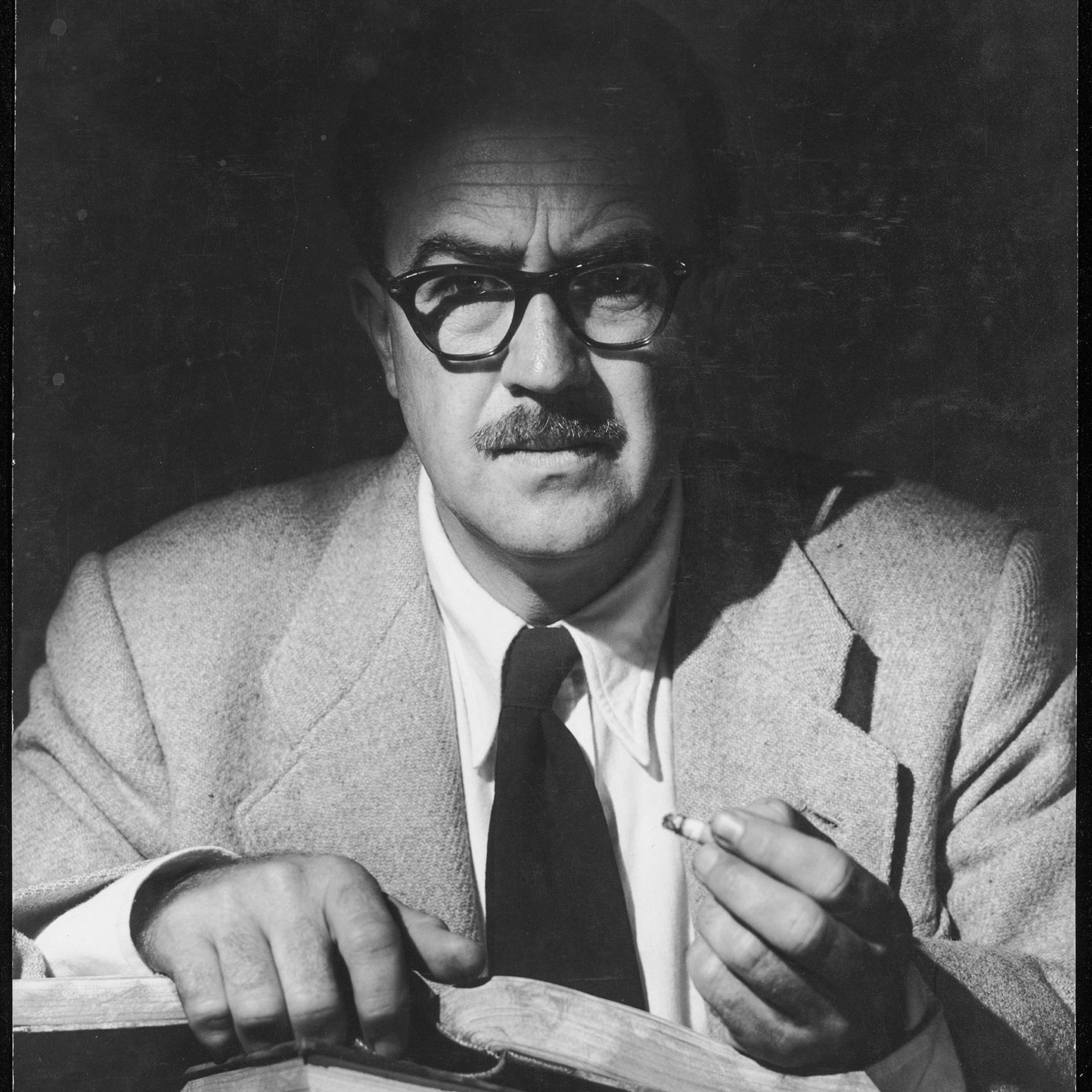
Clement Byrne Christesen (1911–2003)—signing off in writing as CBC, and most commonly known as Clem – was the first editor of Meanjin. Christesen founded the journal in Brisbane in 1940, and then at the invitation of the University of Melbourne, relocated to Melbourne where the University became Meanjin’s custodian and key supporter from 1945. A writer, journalist and commentator, Christesen was a lifelong advocate for the power of literature to stimulate our minds and strengthen our democracy. His extensive archive of papers, letters and editorial correspondence is held in the collection of the Baillieu Library. In recognition of his service to Australia’s cultural life, Christesen was made an Officer of the Order of British Empire in 1962, and awarded a Medal of the Order of Australia in 2000, followed by a Centenary Medal in 2001. He served as editor of Meanjin until 1974.
Image Credit: Detail from a photograph of Clem Christesen (c. 1960) by Athol Shmith. Gelatin silver on fibre-based paper. National Library of Australia obj. 142924848. ©️The Estate of Athol Shmith, Courtesy Kalli Rolfe Contemporary Art.
Footnotes
- Editorial, Spring 1945
↩︎ - Editorial, Spring 1945
↩︎ - Editorial ‘Caring about the arts’, Meanjin 25.1 Autumn 1966
↩︎ - Editorial ‘Caring about the arts’, Meanjin 25.1 Autumn 1966
↩︎ - Editorial ‘Caring about the arts’, Meanjin 25.1 Autumn 1966
↩︎ - Editorial, Meanjin Winter 1941
↩︎ - ‘The Meanjin School’, Meanjin 2.2 June 1943 [transcript of an ABC talk broadcast the year before]
↩︎ - Letter in response to Rupert Murdoch, who had written to Christesen to seek his advice on starting his own new literary magazine, 14 July 1949
↩︎ - Trailer, Meanjin 7.4 Summer 1948
↩︎ - Trailer, Meanjin 7.1 Autumn 1948
↩︎ - Editorial: ‘This Unimagined Australia’, Meanjin 2.4 Summer 1943
↩︎