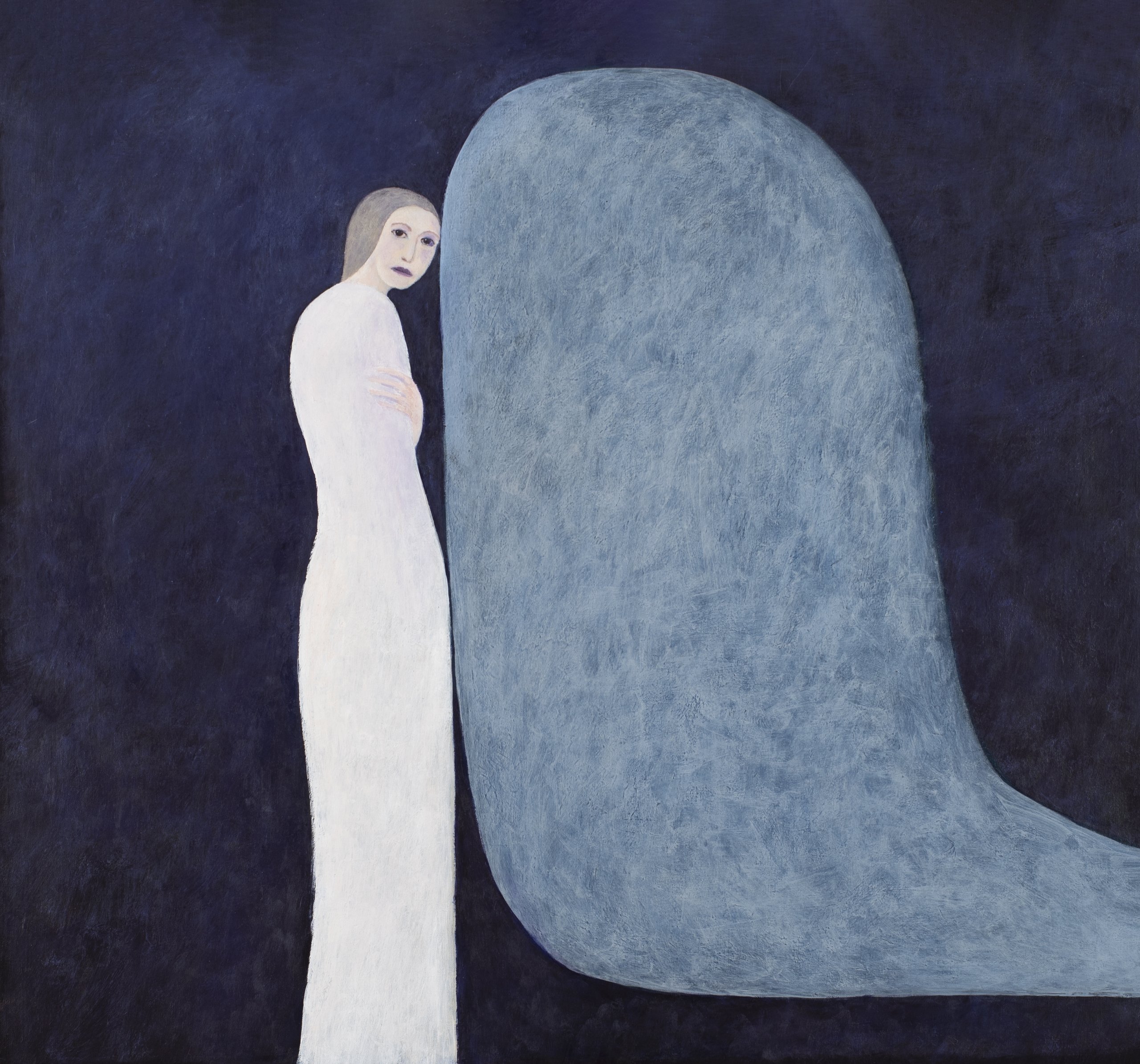
‘My work is situated deep inside my nervous system, and I see the world “feelingly”. Floating around in a metaphorical forest of symbols searching for the pathos in things, I am a leaf in the wind, a daydreamer.’
– Heather B. Swann
In early September, the market noise of Sydney Contemporary threatened to drown out every other art exhibition in this city. But Heather B. Swann’s The Forests of Symbols, UNSW Galleries in Sydney’s Paddington, quietly prevailed.
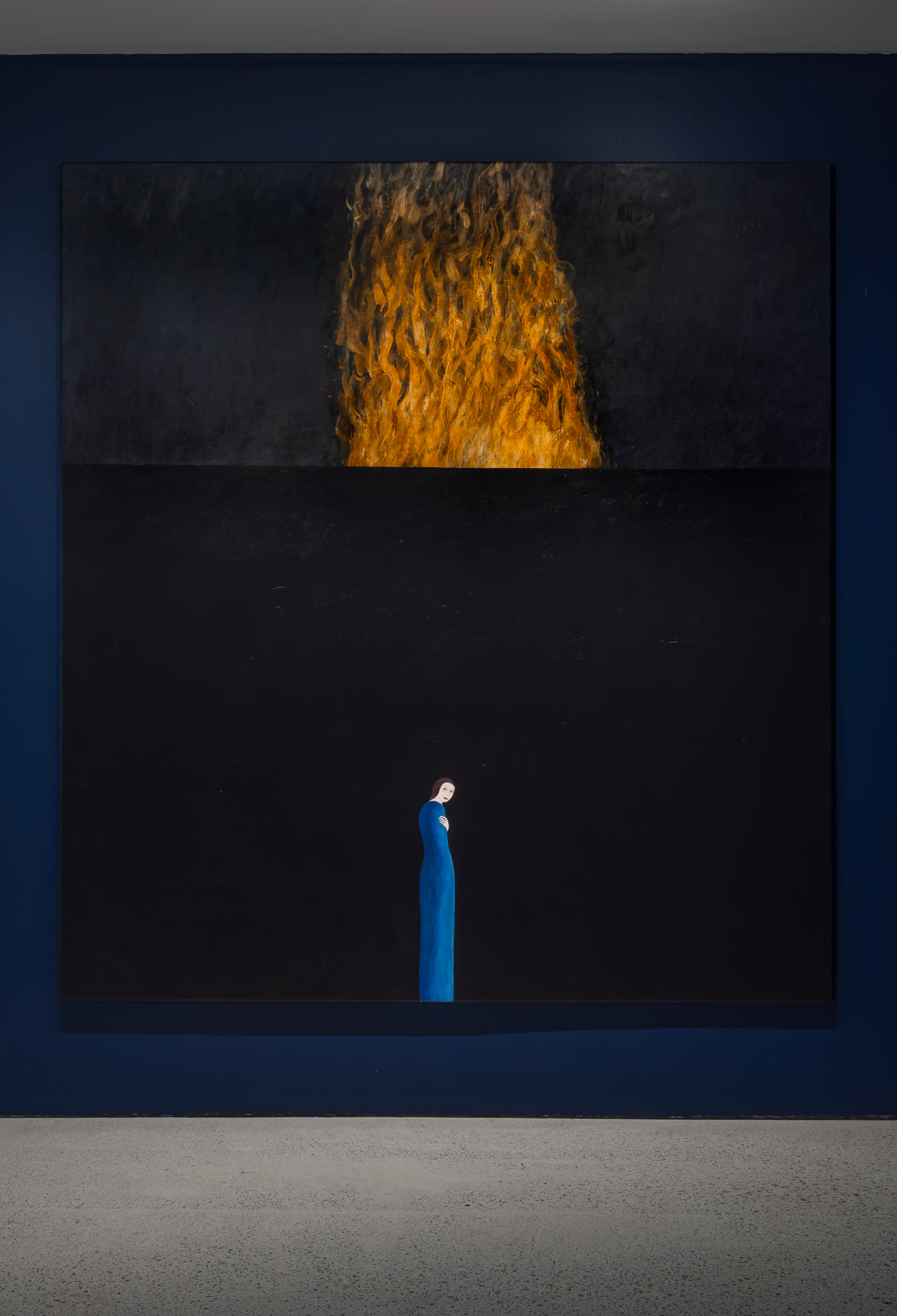
Flanking the entrance to the main space is a large painting dominated by black. The top of the canvas is riven by fire; at the bottom, a diminutive profile of a woman in a long blue robe turns her white face to the viewer. She’s a familiar figure in the work of the Tasmanian contemporary artist, posture always slightly bowed, one hand appearing to cover her chest, hair and robe of different colours. Ladybird (2025) is an ambiguous image, emanating augur, and as such an ideal induction to this luminous, haunting show. The Forests of Symbols has been a year in the making and was commissioned with an $80,000 grant from Copyright Australia Limited. Nearly all the works are recent.
The exhibition’s title comes from ‘Correspondances’, a poem in Baudelaire’s seminal 1857 collection Les Fleurs du Mal. ‘Correspondances’ was not just a paean to Nature as a place in which symbols were inanimate things waiting for a human interpreter; nor were they hostile. The poet invests those symbols – forests of them, including of mineral nature – with agency, so they ‘watch him with familiar eyes’. This animist sensibility enables Swann’s work to transcend the European origin of most of her iconography. ‘I’m an iconoclast – I like to smash symbols,’ Swann told curator José da Silva at her artist talk at the preview on 3 September. ‘But also an iconolater – I like to take them on board and delight in them.’
The result is more counterpoint than conflict.
As a multidisciplinarian, Swann is probably best known for her sculptures yet for me, the two-dimensional works in this exhibition were the most immediately striking. The large paintings like Ladybird, more than two by two metres, stand on the floor, inviting immediate reflection. L’Istituto del corvo nella notte (2026) has a tiny man in a black suit – probably Death – stepping between a de Chirico-like arcade and a black crow on a dais.
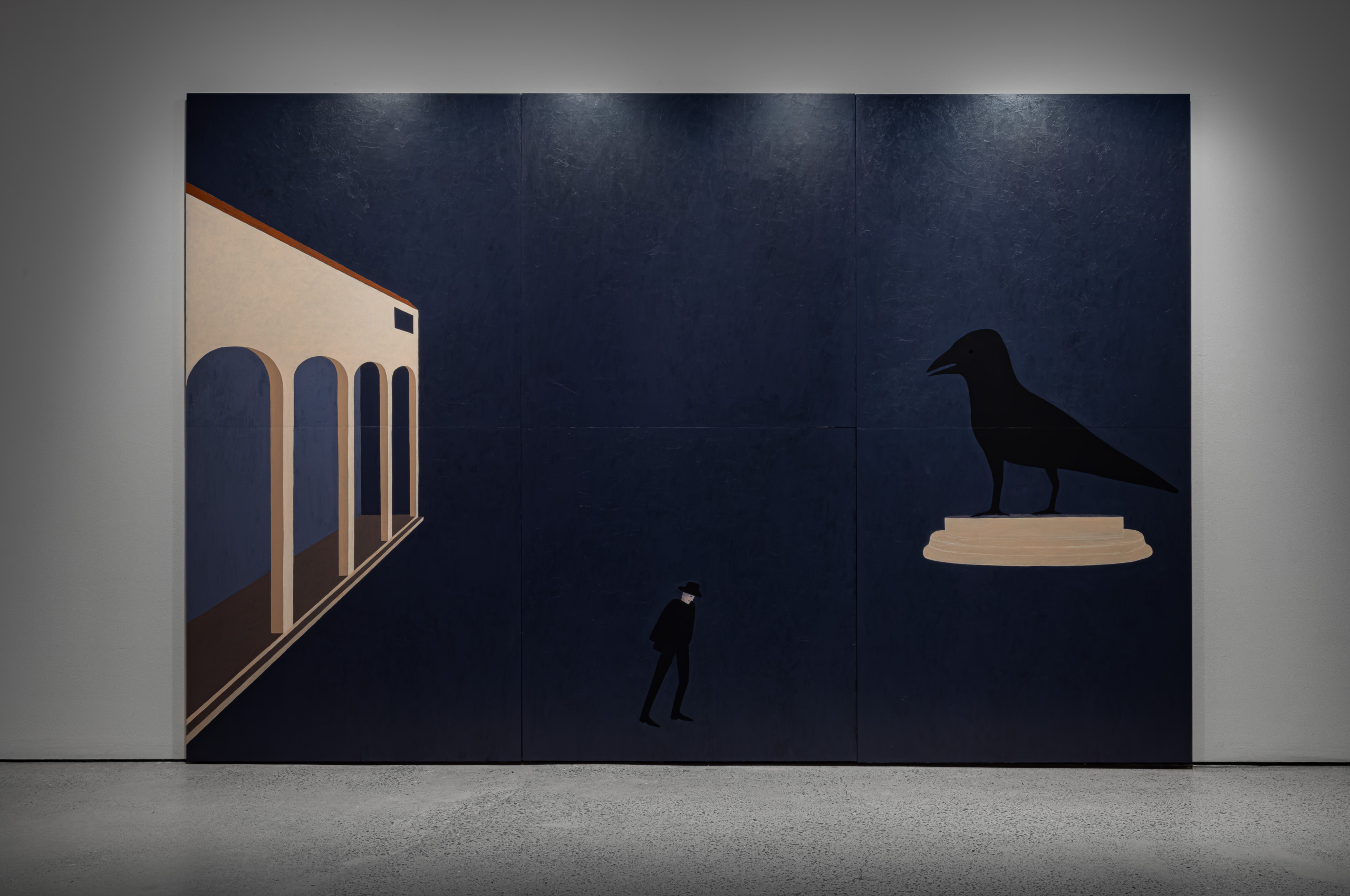
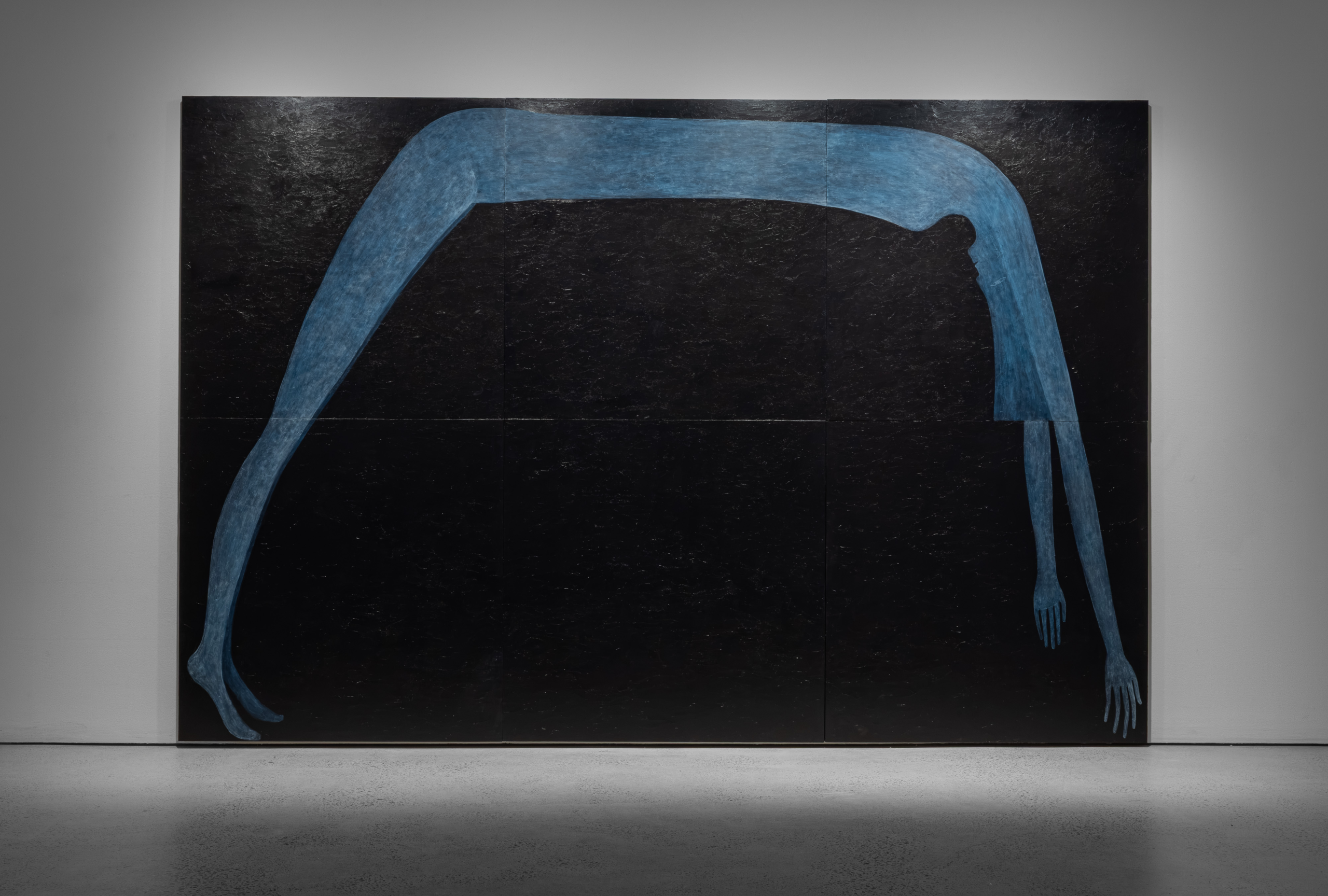
But it is the ocean of Prussian blue which dominates this painting. Swann’s backgrounds are so sumptuous – deep pools of dark rich colour – that they command as much attention as the motifs within them. I liked the way the gallery lit these large paintings too, four lights shining down over the surface, emphasising the textures of brushstrokes. Swann loves black, rendering it with endless variation as an abyss, a pool of rumination, a Rembrandt night. In Nut (2026), a slender pale blue figure representing this 5000-year-old Egyptian sky goddess arches protectively over such a black, leaving us to imagine a sphere – ourselves? Our planet? ‘I’ve never been to Egypt but I’m sure she’s on a keyring, she’s so common,’ Swann told da Silva. ‘I like to play with those sorts of images and shake them up a bit.’
Lovers’ cross (2026) is masterclass in red, warm and womb-like as opposed to Rothko’s mortal wounds. Most of the large paintings – this and the previous two I’ve mentioned – are made up of six panels of plywood, the seams so subtle we only notice variations in the colour field. Our lady in profile reappears in Lovers’ cross, this time blonde, as tall as the painting, touching her cheek to a golden orb on the end of a thick sinuous black line – sexual, amphibian, otherworldly.
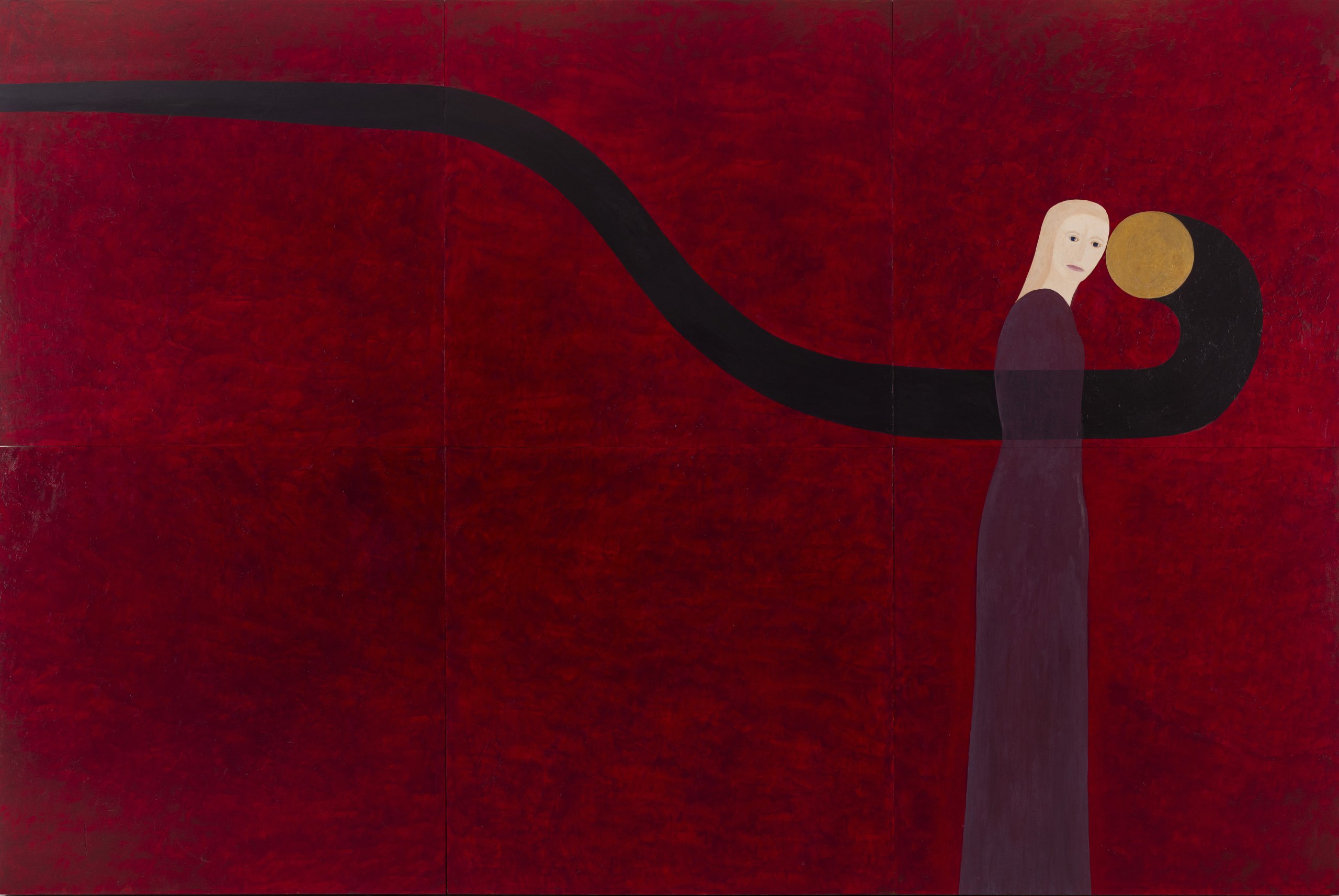
Swann is a big reader – of poetry, novels, history – and with such a trove of references, her work effortlessly triggers multiple meanings: ‘I like to think my work is literary. You can find a story in there. Some of the symbols might have really complicated stories. Other things have personal meaning for me… I like to think anyone can take them and find their own feeling.’ In front of Lovers’ cross is Would I lie to you (2026), a black bench with finely curved legs of forged steel. You can’t sit on the bench due to the giant red lips occupying its length. Plucked straight out of Man Ray’s sky, smoothly sculpted from reclaimed Oregon wood and painted in equally visceral red, these lips beckon, yet prevent us from occupying the bench. I’m sure this piece will end up in MONA.
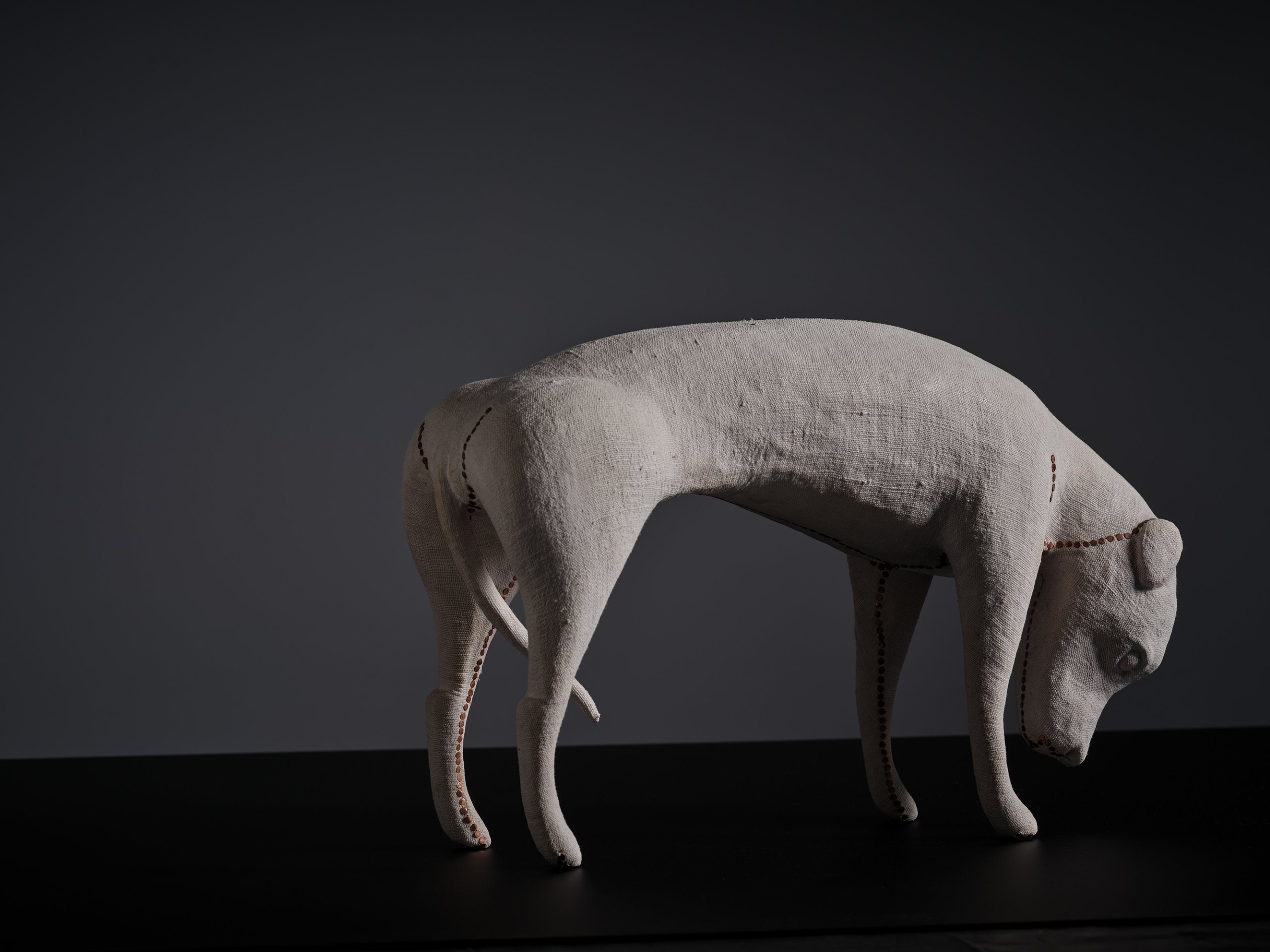
Indeed, when I went back to the gallery for a second viewing, I responded more to the sculptures. The little marionette Josefine (2023) at floor level in the antechamber, capering to a spooky soundtrack commissioned from classical saxophonist Christina Leonard. Lucky boy (2007), a small dog standing in the corner near Nut with its tail between its legs. I loved the inclusion of this older work, how well it fitted for no precise reason. With an elegant linen coat and fine lines of brass tacks holding this figure of pathos together, Lucky shows Swann’s craft at its peak. Crouch to see the eyes of this animal: full of fear and submission.
Swann’s papier-mâché humans appear quite uniform, but also have expressive eyes. A couple wearing green slippers are sentinels to Gallery 2, the multimedia works of which are mostly done in emerald green. From this doorway, too, the expansive sightline all the way through to the end gallery, which features birds, shows da Silva’s astute layout, both in terms of each gallery’s themes and how they connect visually. The greenmen (2026), a stack of wooden boards with glittering glass eyes, recall Swann’s earlier paintings of prickly pears. Two giant canvasses, Frog (2026), are eponymous renditions so pop they jar their refined company. The best work in this gallery is the quirky, enigmatic I will not remember your name (2018), a set of white walking sticks baubled with tiny, individuated heads.
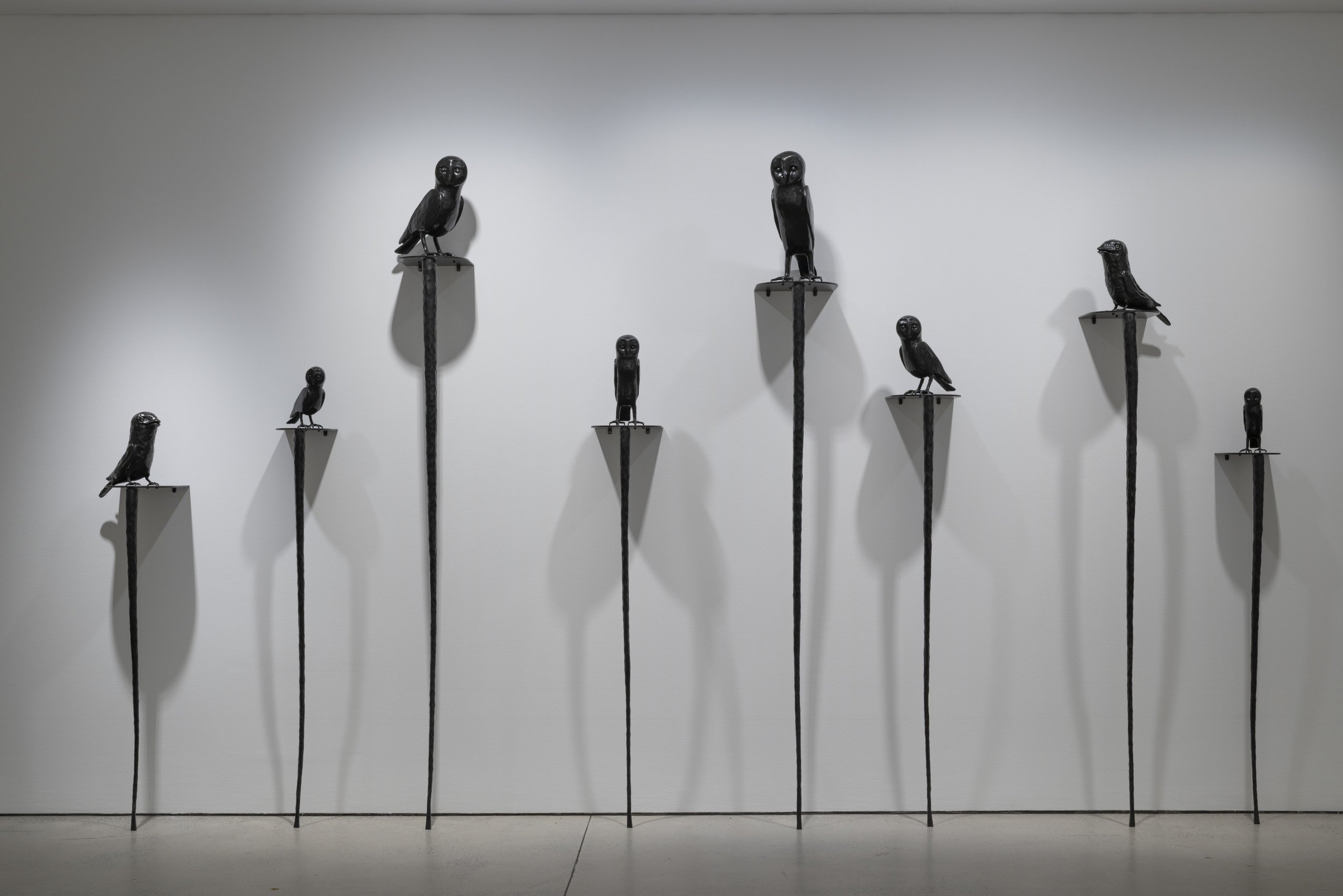
In the end gallery, Night birds (2026), a group of black lacquered owls and two crows, speaks effortlessly to the common thread between so many European and Indigenous Australian nations (and others, elsewhere), of owls and ravens as augurs of death or carriers of the spirits of the dead, or messengers of the spirit world. On a plinth is a patinated bronze bird whose shape suggests a parakeet, but Heart of glass (2017) doesn’t seem genus-specific. Our eye is more drawn to the clutch of precious glass tears suspended before this bird.
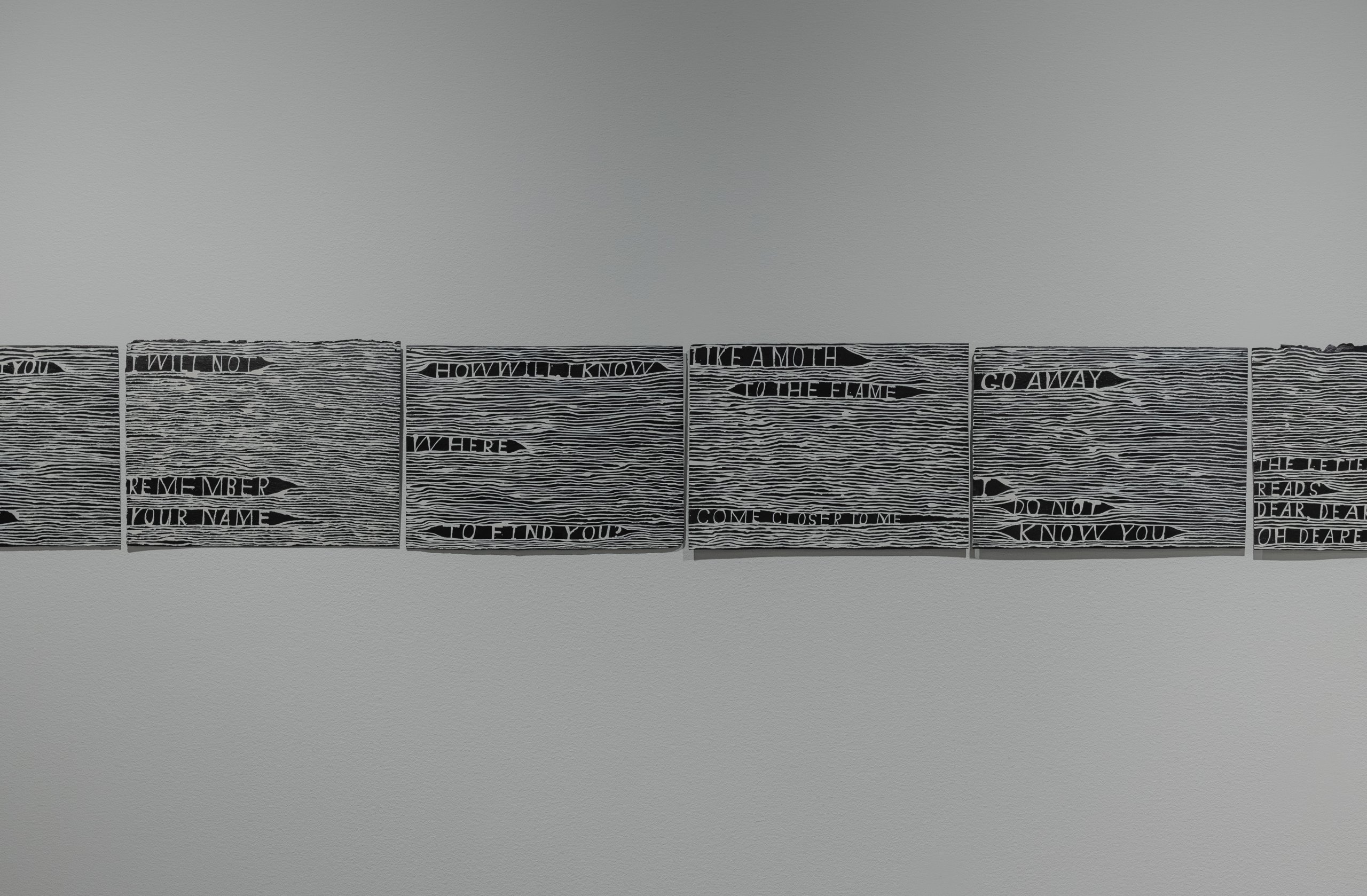
Swann’s lineage to female surrealist artists – from Leonora Carrington to Louise Bourgeois – manifests most in her two-dimensional work. This is partly because the theme of romantic or obsessive love courses through them. And Swann is that rare visual artist, like Tracey Moffat, with an ear for the aphorism balanced between mordant and moving. I will not remember your name includes a sequence of small black and white paintings on paper done in 2025, each containing a phrase which emerges from a sea of fine wavering horizontal lines.
I thought about you all night … I will not remember your name …
How will I know where to find you? … Like a moth to the flame come closer to me … Go away I do not know you …
That lineage is also present in the palette of red-black-white, the elegant, sometimes creepy tendrils Swann elicits from ink. Writing in 2021, curator Beatrice Gralton reckoned that ‘drawing is the heartbeat of Swann’s work’. Swann has crates of notebooks containing decades of drawings which not only track her process – fundamental to the years that sculptures can take to materialise – but also offer unexpected conclusions. ‘I always have notebooks on me and I write and draw in them. I have hundreds of drawings of things I’ve seen in galleries and museums. … I worked in bookstores for thirty years and I learnt to look in every single book. So it’s like being a magpie.’
It was to her notebooks that Swann turned when invited by the Australian Print Workshop in Naarm/Melbourne to make lithographs late last year. Knowing nothing of this technique, Swann formed compositions from their contents driven by intuition. The results line one wall in the UNSW foyer (some were also on sale at Sydney Contemporary). ‘This isn’t a grouping that sits together as a body of work; it’s really me playing with the medium,’ she says.
These are some of the most captivating works in The Forests of Symbols, again because they also draw on Swann’s verbal abilities. Beneath a large butterfly in splotchy red paint, Swann writes –
the delicate inside
OF YOU LIKE A MOTH CLOSE
TO YOUR HEAD and YOU CLOSE
are the FLAME
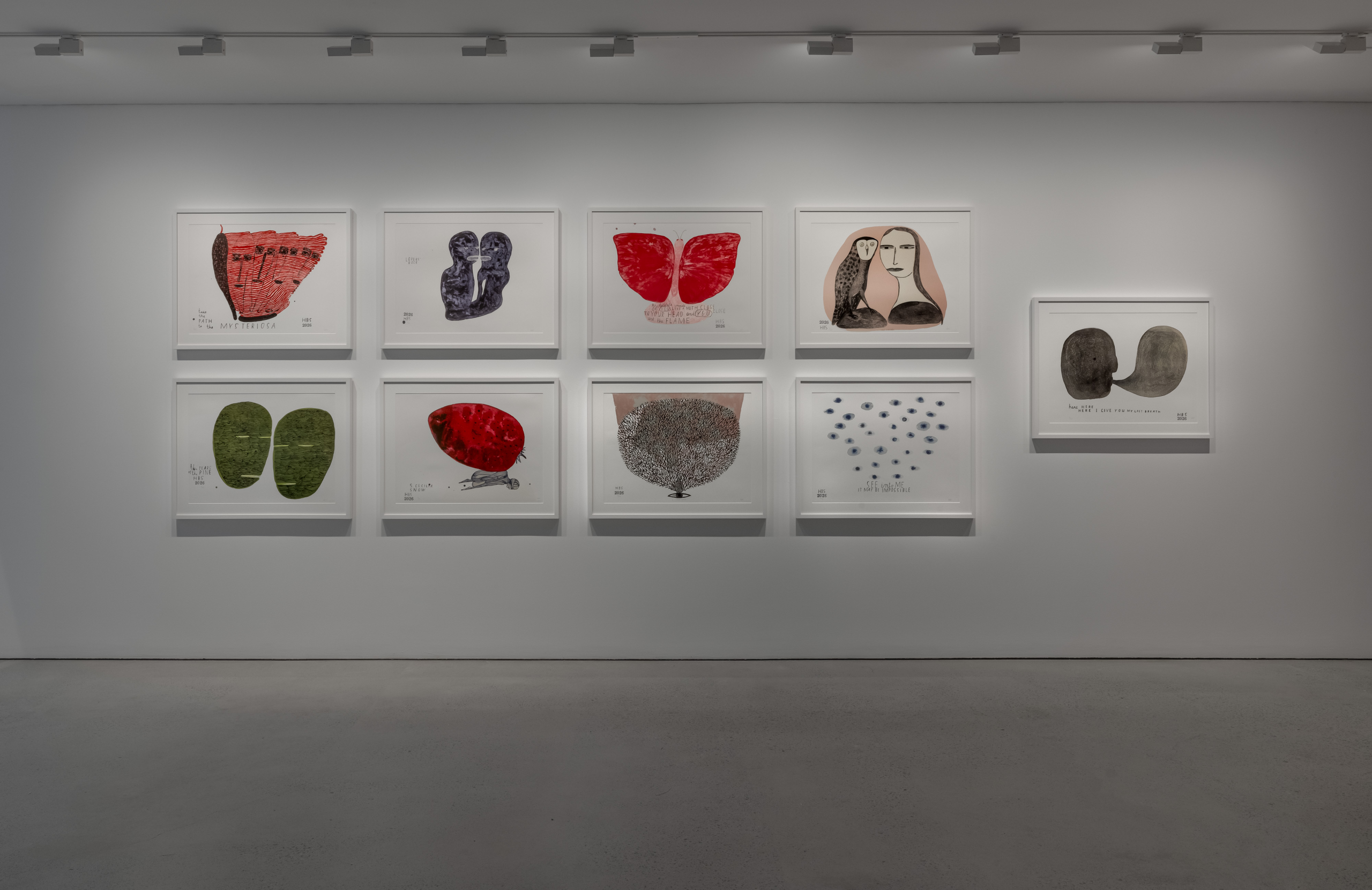
At the artist’s talk, I was struck by how Swann pre-emptively defended her work against the utilitarian mindset which pressures art to respond to our current world – literally on fire from man’s imperial, industrial and ecological aggressions – in a direct, literal manner. ‘It isn’t that I’m not interested in politics in my everyday life,’ she told da Silva. ‘I wanted to make works that had poetry in them. That didn’t need any other justification for being in the world. I think there’s a space for art that is mysterious, a place where we can find our feelings… go slow, read things quietly – shape, colour, metaphor – and feel things deeply.’
I remember Lee Lai articulating a similar defence of the quotidian domesticity in her graphic novel Cannon when it won the 2026 Stella Prize. Artists working in Australia today are up against one of the most viciously capitalist systems in the world. Funding applications are dominated by questions about our market and the purpose of our work. Swann’s art shows the endurance of craft, mystery, motif and lyricism; of the oneiric and the eccentric; of the elemental – fire, forest, bird, rock. Next time I fill out a funding application, I’d like to include Swann’s lithograph of a constellation of blue blobs – amoeba? Eyes? Ink splotches? – with the declaration beneath:
SEE into ME
IT MAY BE IMPOSSIBLE
The Forests of Symbols – Heather B. Swann
UNSW Galleries, 4 September – 22 November, 2026. Curated by José da Silva
…
Fiona Kelly McGregor is a novelist, essayist and art critic whose books include the essay collection Buried Not Dead, and the historical crime diptych Iris and The Trap, recently shortlisted for the Nib Award and longlisted for the ARA Historical Novel Award. When in Sydney, they live on Gadigal country.
