I was standing in line at Mt Druitt Starbucks, the Corned Beef of Western Sydney, scrolling through my Twitter feed. I read that a white New Zealander author named Christina Thompson won this year’s nonfiction Victorian Premier’s Literary Award for her book Sea People: The Puzzle of Polynesia. Clearly Twitter is not always accurate. It turns out that Christina Thompson, a former editor of Meanjin, is an American who also has Australian citizenship. I laughed out loud because I was surrounded by the Islanders, wogs, Filos and bogans of Mounty County as the green mermaid logo of quintessential America stared down at us. What sea?
Later, I went to borrow Thompson’s book from the Blacktown Library. I found Sea People and right next to it Thompson’s first book, Come on Shore and We Will Kill and Eat You All: An Unlikely Love Story. I bit my tongue until it bled at the self-serve check-out. Award-winning Australian literature was telling me that even while white people claimed to love Pacific Islanders, they could only ever see us as either problems to be solved or savage cannibals to be saved, and they were not ashamed to display this sentiment even in the titles of their work.
A critically conscious reader can see Australia through the literature that is missing just as equally as they can through the literature that already exists. Australia’s publishing industry is, to my knowledge, yet to publish a single novel written by an Australian of Polynesian, Micronesian and/or Melanesian descent. Australia’s literary awards industry continuously rewards white people for their colonialist occupation of stories about Indigenous people and people of colour. As a Tongan Australian, I am yet to see myself and people like me as fully formed and autonomous storytellers, even though that is what we are and what we have always been. The Australia I know is Indigenous people and people of colour writing our own stories. I am tired of white people writing for us. No-one asked.
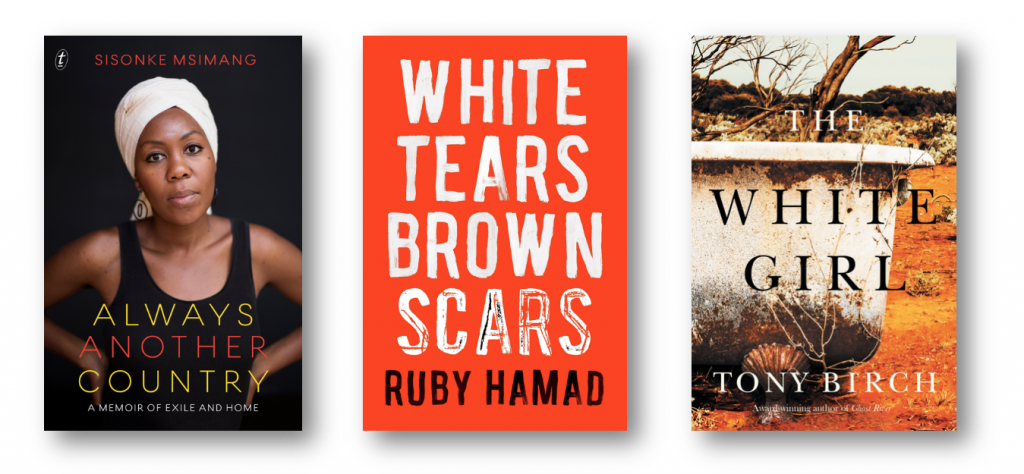
Sisonke Msimang, Always Another Country (2018)
White Australia likes to promote itself as a successful multicultural nation despite its clear attempts to ‘stop the boats’ and to turn people of colour back to ‘where you came from’ because ‘no way will you make Australia home’. This is what Arab-Australian anthropologist Ghassan Hage calls the ‘White Nation Fantasy’, in which white people imagine themselves as the masters of borders and migration in lands that do not belong to them and that are inherently multicultural, whether white people welcome it or not.
Sisonke Msimang’s memoir debunks the fantasy of a white nation through her position as a Black South African woman navigating a culturally diverse terrain. Msimang details her movements from Zambia to Kenya to Canada to Minneapolis to Johannesburg as she transitions from girlhood to womanhood. To know Australia in a book, separate from the white-nation fantasy, is to read about Msimang’s mixed-race children yelling in Aussie accents as they float on their backs in the Indian Ocean; the putrid smell of teeth that violates a small girl nicknamed ‘Sonke’; the taste of blood as schoolgirl Msimang is taunted and dehumanised as a ‘monkey’; the vision of Gogo Lindi with her ‘immaculately plaited head’ giggling with Msimang-the-niece between broadcasts of Radio Freedom and the touch of a loved one’s hand over a dinner table as it rains outside as Msimang, now a woman, finds love that goes against, and somehow resolves, her politics.
To cover such a large scope, Msimang weaves the voices of her younger self and the woman she is at the time of writing in each chapter and in each moment. When Msimang writes, ‘So let us go there. Let us begin with the minute when he says to me, “See?” with all the gentleness of a mild summer day,’ the reader sees how expertly crafted writing can move through the past and present simultaneously. This is an important technique to understand when reading this memoir, because just like migration, even language can be used to move through time and space.
To know Australia is to read Always Another Country with the knowledge that every person of colour who is a migrant in Australia, who is Australian, has their own story, which when they tell it for themselves can never be controlled by the fantasies of borders.
Tony Birch, The White Girl (2019)
Settler, the blacks and superior caste are the first few words to appear in italics in Tony Birch’s The White Girl. These are the phrases that encapsulate the fictionalised twentieth-century story of Odette Brown, an ageing Aboriginal woman who is left to take care of her grandaughter, Sissy Brown, sometimes referred to as a ‘White girl’ due to her blonde hair and light skin. Odette and Sissy Brown reveal the intergenerational trauma Indigenous Blak women live with due to the violence and trauma of white settler colonialism.
The history of colonialism in Australia and the consequent oppression of Aboriginal people are stories I had to learn as an adult because my high school education on First Nations people in Australia was limited to the film Australia by Baz Luhrmann and the end-of-year assembly slideshow, where the bogans of the school clung to the waists of young Aboriginal children as they taught them about a 2000-year-old god from the Middle East who somehow had pale skin and blue eyes. When I grew older and heard of the bloody reality of white Australia’s history, I began searching for works written by Aboriginal people, such as Alexis Wright, Ellen van Neerven, Melissa Lukashenko, Alison Whittaker, Kim Scott, Bruce Pascoe and Tony Birch, which enabled me to see the real Australia beneath a canon that had been whitened.
The White Girl juxtaposes an uncompromisingly Blak and brown narrative with its own title, presenting the complexities, paradoxes and nuances that are built into race relations in contemporary Australia. Birch seems to draw from his own Aboriginal and Afghani heritage to navigate this story, tracing his ancestry along national and international boundaries and bringing it to life in his characters. The most interesting characters to me are Millicent Khan, a strong-willed and cigar-smoking Aboriginal woman, and her husband, Yusuf Khan, an Afghani Muslim man who domesticates wild horses. Their interracial and interfaith marriage was new information to me. My high school education had led me to believe that Australia’s past was purely Blak and white. Yet Millie Khan reveals to me Australia’s more truthful and colourful history when she stands strongly in front of a white police officer and explains:
I enjoy no support from the State, as you call it, Sergeant. My name is Mrs Millicent Khan. I am the wife of Mr Yusuf Khan. He’s a free man whose father came to this country from the Punjab. My husband purchased the property we live in with hard-working money from the old stockman who took it away from my people and then hired my own father to work for him. Me and Yusie paid good money for a path of land stolen from my people. Our children and grandchildren, all of them inherited the Khan name. We take nothing from the government, we are free to do as we want.
This is Australia as I know it best, Indigenous people and people of colour in solidarity with each other for freedom and justice by any means necessary.
Ruby Hamad, White Tears/Brown Scars (2019)
‘White women’s racial privilege is predicated on their acceptance of their role of virtue and goodness.’ This is a line from Ruby Hamad’s debut work of nonfiction, White Tears/Brown Scars, which stayed with me long after I had finished the book.
My first confrontation with the tears of white women was while I was on a Sydney Writers’ Festival panel titled ‘Owning Your Story’. Along with Omar Sakr, Shirley Le, Monikka Eliah, Stephen Pham and Evelyn Araluen, I spoke about the art of creative writing and the importance of writing stories from our own intersectional voices. At question time, a white woman stood up in the middle of the audience, with a spotlight shining down on her, and complained about a moment where I had used the words ‘shit’ and ‘white people’ in the same sentence. Rather than focusing on the social, systemic and structural issues of racism and white supremacy that the six of us on the panel were attempting to expose, the white woman constructed herself as the well-meaning victim of our wrath and began to cry.
Shortly after that panel, Ruby Hamad wrote an article for the Guardian titled ‘How white women use strategic tears to silence women of colour’. With this Sydney Writers’ Festival incident as just one of the reference points in the article, Hamad details how white women have been using their tears strategically to demonise people of colour, to derail conversations about race and to centre their own hurt feelings above the institutional racism people of colour experience regularly.
White Tears/Brown Scars is a closer and in-depth analysis into the phenomenon of white tears. These tears create a dangerous binary that establishes white women as damsels of purity for the colony to protect while women of colour are animalistic in their rage and promiscuity. From the ‘exotic Orientals’ to the ‘dragon ladies’, Hamad’s essays outline the stereotypes that have haunted women of colour from the past into the present. The Australia in this essay collection builds upon earlier feminist research, looks outwards from Hamad’s perspective as an Arab-Australian Muslim woman, gathers evidence from our gendered and racialised world views, and sets this information at the foot of every white woman in this country, who now must come to terms with her hand in the history of racism, white supremacy, white privilege, xenophobia and colonialism.
In a country where the social hierarchy is often navigated through the binaries of male and female, black and white, rich and poor, heterosexual and LGBTIQ+, rather than through the dynamic interplay between complex intersections of race, class, gender and sexuality, White Tears/Brown Scars offers a refreshing and nuanced examination of identity politics in a land where sovereignty was never ceded. •
Winnie Dunn is a Tongan-Australian writer from Mt Druitt. She is the general manager of Sweatshop: Western Sydney Literacy Movement and is the editor of Sweatshop Women.